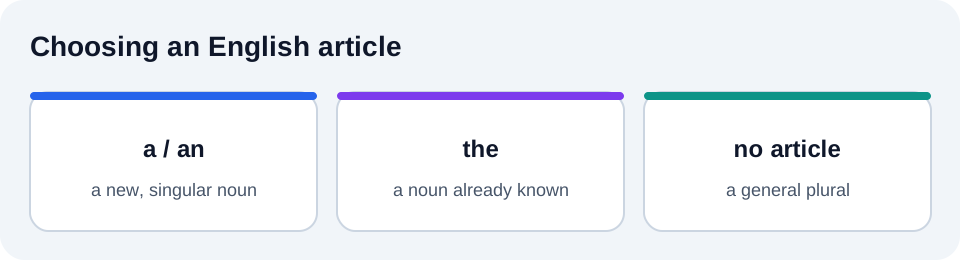
English has three choices in front of a noun: a/an, the, or nothing at all (the zero article). The core logic is short: a/an is chosen by the first sound of the next word (an hour, a university), "the" points to something the listener can identify, and no article covers general plurals, abstract nouns, and most proper names. What makes articles hard is applying that logic at speed, on nouns that switch meaning — school vs the school, experience vs an experience.
The 30 sentences below are sorted from warm-up to challenge, and every option you click is checked instantly. Each explanation tells you which rule applies — so if you miss one, you learn the rule, not just the answer.
A, An, The Quiz: 30 Questions
Warm-up · the basic rules
Core · the rules that decide real writing
Challenge · the sentences that trick everyone
Answer key and explanationsOpen after you finish the quiz.
- 1. TheThere is only one sun, so it is unique — unique things take the. The same logic covers the moon, the sky, and the internet.
- 2. anEngineer starts with the vowel sound /e/, so an is correct. When you say what job someone does, English needs a or an: she is an engineer, he is a teacher — not she is engineer. The exception is a unique post held by one person: She is head of sales. He was elected president.
- 3. aThe laptop is mentioned for the first time and the listener cannot know which one — that is exactly what a does: it introduces one non-specific item.
- 4. theBoth speakers can see the salt and know which salt is meant — a shared, specific thing. That shared knowledge is the signal for the.
- 5. theMusical instruments played as a skill traditionally take the: play the guitar, play the piano — even though no specific guitar is meant. Play guitar without the is also common, especially in American English and when talking about bands, but a guitar is wrong here.
- 6. aUniversity is written with a vowel but starts with the consonant sound /juː/ (like you). The rule follows sounds, not letters — so a university, an umbrella.
- 7. No articleMeals — breakfast, lunch, dinner — take no article in the general sense: have dinner, have breakfast. Only a specific meal event takes the: the dinner we had at the wedding.
- 8. No articleSingle mountains with Mount/Mt. in the name take no article: Mount Fuji, Mount Everest. Mountain ranges are different — the Alps, the Himalayas.
- 9. aNot even the speaker knows which hospital, so it cannot be identified: a hospital. Once both of you know which one, it becomes the hospital.
- 10. anThe h in hour is silent — the word starts with the vowel sound /aʊ/. An hour, an honest man, but a history book (the h is pronounced).
- 11. TheAn adjective describing a whole group of people becomes a group noun with the: the rich, the poor, the elderly. It always takes a plural verb.
- 12. anMBA is pronounced em-bei-ay — it starts with a vowel sound, so an MBA. Abbreviations follow their spoken first sound, not their first letter.
- 13. No articleGo to school means attend as a student — the institution in general, so no article. Go to the school means go to the building, for any other reason.
- 14. theThe best identifies the particular movie ranked highest among those I have seen. Superlatives often use the, but a possessive can replace it: my best friend. Ordinals can also follow possessives, as in our first visit.
- 15. theCountries with plural names or containing union/kingdom/republic take the: the Netherlands, the Philippines, the United Kingdom. Most single countries take nothing: Japan, Brazil.
- 16. aEuropean starts with the consonant sound /j/ (yur-oh-pean), so a European city. Compare: an EU regulation (ee-oo starts with a vowel sound).
- 17. theThere is one obvious light in the room — speaker and listener both know which one. In everyday situations where the reference is obvious, English uses the.
- 18. No articleAbstract nouns used in a general sense — honesty, happiness, love, information — take no article. The moment you narrow them down, the can appear: the honesty he showed.
- 19. anAstronaut starts with the vowel sound /æ/, so an. Careers and aspirations use a/an because they name one unspecified member of a profession.
- 20. the … no articleA famous asymmetry: listen to the radio (with the) but watch television (no article) when speaking of the medium in general. Both are fixed patterns to memorize.
- 21. aOne is pronounced /wʌn/ — it begins with a w sound, so a one-day workshop. Vowel spelling, consonant sound: a wins.
- 22. TheMountain ranges always take the: the Alps, the Andes, the Himalayas. Compare single peaks: Mont Blanc, Kilimanjaro — no article.
- 23. No articleBe sent to prison means enter the institution as a prisoner — no article. His mother went to the prison to visit him: the building as a place, so the.
- 24. TheStates is plural, and plural-form country names take the: the United States, the Netherlands, the UAE. This is one of the most common article slips in formal writing.
- 25. No articleExperience as an uncountable abstract noun takes no article. With a different meaning it can take one: an unforgettable experience (one event, countable).
- 26. aExclamations with what + singular countable noun take a/an: What a lovely surprise! Plural and uncountable versions take nothing: What lovely flowers!
- 27. anHeir begins with a silent h — it is pronounced /eər/ — so an heir. English spelling preserves the h from French, but the article follows the sound.
- 28. anRates per unit take a/an: $80 an hour, twice a week, 60 km an hour. The silent h in hour makes it an, and the pattern a/an here means per.
- 29. aUseful starts with /juː/ — a y-sound — so a useful app. Many learners overcorrect to an after mastering an hour; the sound rule settles it both ways.
- 30. TheA specific, identified dinner event takes the — the listener knows which dinner (the one at that new restaurant). General have dinner stays article-free.
The 3-Second Article Decision
Every article choice answers one question: does the listener know exactly which thing I mean? If yes, use the. If no, ask a second question: is it one countable thing? Then use a or an. Everything else — plurals in general, abstract nouns, most names, meals — takes no article at all.
- the → both speakers know which one: the sun, the salt, the best movie.
- a / an → one of many, first mention, jobs and rates: a laptop, an engineer, $80 an hour.
- no article → general plurals, abstract nouns, meals, most countries and people's names: Books are expensive. Honesty matters. Have breakfast.
- a or an? → listen to the first sound, never look at the first letter: an hour, a university, an MBA, a one-day workshop.
Read your sentence aloud before choosing a or an. Your ear catches the vowel/consonant sound faster than your eye catches the letter.
A or An? It's the Sound, Not the Letter
The a/an rule is about pronunciation, which is why spelling-based learners get it wrong on exactly the same words: hour, honest, heir (silent h → an) and university, useful, European, one (y/w sounds → a). Abbreviations follow their spoken form too: an MBA (em), a US citizen (you-ess).
- an hour, an honest answer, an heir — silent h.
- a university, a useful app, a European city, a one-day trip — consonant /j/ or /w/ sound.
- an MBA, an FBI agent, an SMS — letter names starting with a vowel sound.
- a NATO meeting, a UNESCO site — acronyms read as words follow the word's first sound, not the letter names.
When to Use 'The'
The does one job: it tells the listener you both know which thing is meant. That shared knowledge can come from uniqueness (the sun), from the situation (the light, the door), from an earlier mention (I bought a laptop… the laptop is fast), from superlatives (the best), or from fixed patterns like musical instruments and media (play the guitar, listen to the radio).
- Unique: the sun, the moon, the internet, the world.
- Second mention: I saw a dog. The dog was huge.
- Superlatives and order: the best, the first, the only.
- Groups: the rich, the elderly, the Dutch.
- Names that take the: rivers (the Nile), ranges (the Alps), plural countries (the USA), oceans (the Pacific).
First Mention, Second Mention: How Articles Track a Story
In connected writing, articles do bookkeeping. A new thing enters with a or an; once it is on the table, every later reference to the same thing uses the, because the reader now knows which one you mean.
I saw a dog in the park. The dog was chasing a ball, and the ball rolled under a bench. I sat on the bench to watch.
Read that back and notice the rhythm: a dog → the dog, a ball → the ball, a bench → the bench. If you write I saw the dog at the start, the reader assumes they should already know which dog — which is exactly the confusion article errors create in emails and reports.
Behind this sits a stricter rule: a singular countable noun cannot stand alone in English. It needs a/an, the, or another determiner such as my, this, or every. I have car and Please send me report are not shortened English; they are missing a required word.
When to Use No Article (the Zero Article)
English leaves the article out far more often than learners expect. General plurals, uncountable and abstract nouns, institutions-as-purposes, meals, languages, sports, and most proper names all go bare. The trap is that the same noun can switch: school (purpose) vs the school (building), prison (sentence) vs the prison (place), television (medium) vs the television (device).
- General plurals: Cars pollute cities. Children learn fast.
- Abstract/uncountable: Information is free. Patience helps.
- Institutions: go to school / bed / prison / church (as a participant).
- Meals: have breakfast / lunch / dinner.
- Transport: by train, by bus, by car (no article) — but take the train, get on the bus.
- Most names: Japan, Lake Biwa, Mount Fuji, English, tennis.
Why Your First Language Makes Articles Hard
If your first language has no articles at all — Japanese, Korean, Chinese, Indonesian, Russian, Turkish — nothing in your grammar forces you to mark whether a noun is new or already known, so articles get dropped under time pressure (I have meeting at three). You usually know the rule; the decision just is not automatic yet.
Arabic is a halfway case: it has a definite article (al-) but no indefinite one, so Arabic speakers tend to keep the and drop a/an (He is engineer), and sometimes add the to general statements because al- covers general meaning too (The honesty is important).
If your first language has articles, they map differently. Spanish, Italian, and French use the definite article for general statements, so speakers write The life is hard or The love is important where English wants Life is hard. German has articles in similar places, but uses them with some abstract nouns and institutions where English drops them (in der Schule → at school).
Check your own writing in two passes: first find every singular countable noun and make sure it has a/an, the, or my/this/etc.; then find every general statement and make sure it has no the. Those two passes catch the errors described above.
Using Articles in Your Own Writing
Reading the rules once does not make article choices automatic; making many quick decisions and seeing the correction straight away does. Redo the questions you missed a day later, and say the full sentence aloud each time, because a/an is a sound decision before it is a spelling one.
Then move the drill into your own writing. PromGee's free grammar checker flags article decisions in text you paste in and explains the rule it applied, so your real emails become your next exercise set.
Keep practicing
Frequently Asked Questions
What is the rule for a vs an?
Choose by the first sound of the next word, not its spelling: an before a vowel sound (an apple, an hour, an MBA) and a before a consonant sound (a book, a university, a one-day trip). Silent letters and y/w sounds are what create the exceptions.
When should I use 'the' in English?
Use the when the listener knows exactly which thing you mean — because it is unique (the sun), already mentioned (a car… the car), obvious from the situation (the door), modified by a superlative (the best), or part of a fixed pattern (play the piano, the radio).
When is no article needed in English?
No article (the zero article) is used with general plurals (Dogs are loyal), uncountable and abstract nouns (Water boils, Honesty matters), institutions used for their purpose (go to school, be in prison), meals (have dinner), languages, sports, and most proper names (Japan, Mount Fuji).
Fix Article Mistakes in Your Own Writing
Paste any email or essay into PromGee's free grammar checker and see each article decision explained in plain language.
Check My Writing Free