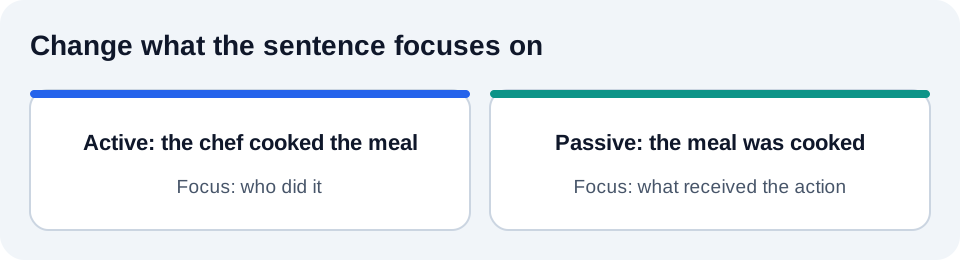
Voice is about who does what. In the active voice, the subject performs the action: Our team fixed the bug. In the passive voice, the subject receives the action: The bug was fixed. Both sentences are grammatically correct. The choice between them is a communication decision, not a grammar decision — and once you understand what each one signals, you will stop over-correcting and start writing with intent.
What Active & Passive Really Are
Active voice follows the natural action chain: doer → action → receiver. Passive voice flips it: receiver → be + past participle → (by doer). The “by” phrase is optional in passive sentences, which is precisely why passive can hide who acted.
| Voice | Structure | Example |
|---|---|---|
| Active | Subject + verb + object | Marketing launched the campaign. |
| Passive | Object + be + past participle (+ by) | The campaign was launched (by Marketing). |
Spotting passive is easy: look for a form of be (is, was, are, has been) followed by a past participle (launched, written, sent) — and check whether the subject is doing the action or receiving it.
Convert awkward passive sentences into punchy active writing
Not sure if your sentence sounds too passive or timid? Paste it into our Free Sentence Corrector to get clear, active phrasing in one click.
Why Active Is the Default
Active voice is shorter, more specific, and more actionable. In a business context, it tells your reader exactly who is accountable, which is what most messages need. Compare these two client updates:
The active version names the sender, which builds trust and makes follow-up questions easier. When you do not know the doer, when the doer is irrelevant, or when naming the doer would create a problem, that is when you reach for passive — not before.
The 4 Times Passive Is Superior
1. Admitting a mistake diplomatically
Passive removes the accusatory edge when something went wrong. Active: You failed to send the files. Passive: The files were not received. The passive keeps the conversation on solving the problem instead of assigning blame.
2. The doer is unknown or unimportant
When it does not matter who acted, passive keeps the focus on the fact. The server was rebooted at 3 a.m. Nobody cares which engineer did it; the event is the message.
3. The receiver matters more than the doer
Lead with the thing that changed, not the person who changed it. The proposal was approved by the board. The proposal is your subject; the board is background detail.
4. Writing technical incident reports
Formal reports often need neutral, blame-free language. A configuration error was introduced during the deploy. The passive records what happened without starting a blame hunt.
Active Voice on a Resume
Recruiters spend seconds scanning a resume, and they are trained to look for action verbs that prove impact. Active voice is non-negotiable on a resume — it is the difference between describing a job and demonstrating achievement. Pair it with the subtle writing upgrades that make you sound more intelligent and your bullets do double duty.
| Weak (passive) | Strong (active) |
|---|---|
| Was responsible for the sales team | Led a sales team of 6 |
| Was given the quarterly report | Compiled the quarterly report |
| Sales were increased by 20% | Increased sales by 20% |
| Training was conducted for new hires | Trained 15 new hires |
Rule for resumes: start every bullet with a strong active verb in the past tense, and always let “you” be the implicit subject. If a bullet would sound natural in the passive voice, rewrite it.
Passive in Professional Emails
Email is where the diplomatic passive earns its keep. When you need to follow up on a payment, chase a task, or flag a delay, passive phrasing keeps the tone professional instead of confrontational. For the full picture, pair this guide with the grammar mistakes that ruin business emails.
Note the trade-off: the passive version is softer, but it is also vaguer. Pair it with a clear active next step so the email stays actionable: The payment has not been received yet. Could you confirm when you sent it?
Passive in Incident Reports
Incident and status reports are the classic exception to “avoid passive.” Neutral language keeps an operational review objective, especially when a human error is involved. The goal is to record events, identify causes, and prevent recurrence — not to name and shame.
The passive voice here is not laziness — it is protocol. It keeps the focus on systems and outcomes, which is exactly what an operational review needs.
Before / After Rewrites
Rewrite passive sentences by finding the doer, moving it to the subject position, and adjusting the verb. If you are unsure whether a rewrite reads naturally, run it through a free English grammar checker before you hit send. Here are four realistic business rewrites.
| Passive | Active |
|---|---|
| The meeting was rescheduled by the manager. | The manager rescheduled the meeting. |
| A discount was offered to the customer. | We offered the customer a discount. |
| The budget was approved by the CFO. | The CFO approved the budget. |
| The files were uploaded by the intern. | The intern uploaded the files. |
The Over-Correction Trap
Advice like “never use passive” creates a different problem: writers bend their sentences into unnatural active forms to avoid it. Two symptoms of over-correction are worth recognizing.
The real skill is not avoiding passive — it is choosing voice deliberately. Use active when you want clarity and ownership; use passive when you want neutrality and diplomacy. Read each sentence and ask: “Who needs to act on this, and what tone does this situation require?”
Test Yourself
Rewrite each passive sentence in the active voice, then check the answers. Where no doer exists, supply a natural one.
1. The contract was signed by both parties on Friday.
Answer: Both parties signed the contract on Friday.
2. The report was finalized this morning.
Answer: We finalized the report this morning. (infer the team/author)
3. The customer was sent a follow-up email.
Answer: We sent the customer a follow-up email.
4. The proposal was rejected by the client.
Answer: The client rejected the proposal.
5. Our annual targets were exceeded.
Answer: We exceeded our annual targets.
6. The training session was cancelled.
Answer: We cancelled the training session. (or HR cancelled…) — acceptable if the doer is genuinely unimportant to keep passive.
Turn Voice Awareness into a Writing Habit
Voice is a habit, and habits change through editing practice. Start by auditing your last ten work emails: highlight every passive sentence, then rewrite the ones where active would improve clarity. Over time, you will start choosing voice at the moment of writing instead of fixing it afterward.
PromGee’s grammar and writing-style categories include focused practice on sentence structure, so you can train the same decisions in short drills. The AI explains why a rewritten version sounds clearer to a native reader — turning an abstract rule into a concrete feel.
Print a two-line checklist and keep it by your desk: “Active when I want clarity and ownership; passive when I want diplomacy or neutrality.” That single decision rule will improve your business writing more than any grammar book.
Active voice puts the doer first and is your default for clarity, ownership, and resumes. Passive voice moves the receiver first and is your tool for diplomacy, unknown doers, receiver-focused statements, and neutral incident reports. Find the doer to rewrite passive as active, and never force an unnatural sentence just to avoid it. Voice is a choice — make it deliberately.