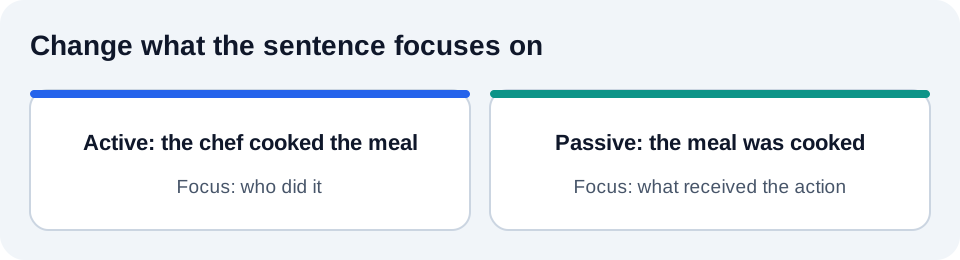
Passive voice exercises with answers train one core pattern: form the passive with a form of be plus the past participle, and let be carry the tense — is built, was built, has been built, will be built. In the passive the subject is the thing acted on, not the doer, so the action moves to the front and the actor often disappears.
The 25 questions below run from warm-up to challenge and cover the cases that trip everyone up: the continuous passive (is being cleaned), two-object verbs (I was given a raise), reporting passives (it is said that she left), and the verbs that simply cannot go passive — accidents happen, and was happened is never correct. Every sentence is checked as you click, with no signup, and each miss explains the rule in one line.
Passive Voice Quiz: 25 Questions
Warm-up · be + past participle
Core · tenses, agents, and continuous passives
Challenge · modals, reporting passives, and agents
Answer key and explanationsOpen after you finish the quiz.
- 1. was writtenyesterday puts it in the past and the report receives the action, so past simple passive = was + past participle: was written (the participle of write is written, not wrote).
- 2. was builtA finished date (1889) with a patient subject takes past simple passive: was + past participle = was built. is built would wrongly place it in the present.
- 3. is spokenA general truth uses present simple passive: is/are + past participle. English is the thing spoken, so is spoken — English does not speak.
- 4. are cleanedwindows is plural, so the passive auxiliary is are + past participle: are cleaned. is cleaned would be wrong because the subject is plural.
- 5. were announcedPlural results + last week (finished past) takes were + past participle: were announced. have announced is active, with the results wrongly cast as the doer.
- 6. was servicedThe car is acted on and yesterday is past, so was + past participle: was serviced. has serviced is present perfect active — it would need a person as the subject.
- 7. have been sentThe plural subject invitations needs have, and a passive perfect uses have been + past participle. Of these options, only have been sent has the required form; already alone does not require the present perfect in every context.
- 8. is being cleanedAn action in progress right now uses present continuous passive: is being + past participle = is being cleaned. is cleaned is present simple (a habit), not happening now.
- 9. was being reviewedThe review was still in progress at that past moment, so past continuous passive: was being + past participle = was being reviewed.
- 10. was givengive has two objects (someone something). Making the recipient I the subject gives was + past participle: I was given a promotion.
- 11. was givenWith the thing given as the subject, use was + past participle + to-phrase: A raise was given to all employees — the other correct shape of the same two-object verb.
- 12. The accident happened last night.happen is intransitive — it has no object to become a subject — so it has no passive form at all. was happened / has been happened are always wrong.
- 13. was breachedThe firewall did not do the breaching; something was done to it, and the attackers are unknown. So the passive is the natural choice and the by-agent is simply dropped: The firewall was breached.
- 14. was passedHere the actor (Parliament) is genuinely the news, so the passive keeps an explicit by-agent: was passed by Parliament.
- 15. got firedgot fired is the informal got-passive — fine in speech. In formal writing, prefer the was/were form: he was fired.
- 16. The store is closed.In The store is closed, closed is an adjective describing a resulting state (stative passive). is being painted/repaired/built all describe actions still happening.
- 17. needs washingAfter need, a gerund carries passive meaning: needs washing = needs to be washed. needs to wash wrongly makes the carpet the doer; needs washed is non-standard.
- 18. be finishedAfter a modal like must, the passive is be + past participle: must be finished. be keeps the passive and the modal keeps the tense/attitude.
- 19. It is saidThe impersonal reporting passive is It is said + that-clause — used for general, unattributed reports. It is said does not name who says it.
- 20. is saidIn the personal reporting passive, the reported person is the subject and is said takes a to-infinitive: She is said to have left.
- 21. will have been completedBy + a future deadline calls for future perfect passive: will have been + past participle = will have been completed (done before that future point).
- 22. are requiredThe visitors do not do the requiring; the rule (or the company) requires it of them. Verbs like require, ask, expect, and allow take the passive + to-infinitive in rules and notices: are required to wear, are asked to sign in, are not allowed to park.
- 23. The decision has been made.Present perfect passive = has/have been + past participle: has been made (singular decision takes has; the participle of make is made).
- 24. The plan was agreed to by everyone.Only verbs used with an object can be passivized, so agree to (the plan) becomes The plan was agreed to. happen has no object and therefore no passive.
- 25. The experiment was carried out in June.Formal and academic prose uses was/were + past participle, not the informal got-passive: The experiment was carried out in June.
How the Passive Is Built
Every passive in English is the same recipe: a form of be + the past participle. The verb be carries all the tense, number, and aspect, while the main verb freezes into its past participle. That is why the passive can sit in any tense — you just conjugate be and keep the participle fixed.
- Present simple: is built / are repaired.
- Past simple: was built / were announced.
- Present continuous: is being cleaned / were being reviewed.
- Present perfect: has been sent / have been made.
- Future: will be finished / will have been completed.
- With a modal: must be done / can be repaired / should be reviewed.
Spot a passive two ways: a form of be (or get) followed by a past participle, and a subject that receives the action instead of doing it. If you can add 'by zombies' and the sentence still works — the book was written by zombies — it is a passive.
When the Passive Is the Better Choice
The passive is not a style error to avoid at all costs; it is a tool that puts the patient first. Use it deliberately whenever the doer is unknown, obvious, or unimportant, or when you want the action — not the actor — in the spotlight.
- Actor unknown: My bicycle was stolen. (I do not know who did it.)
- Actor obvious: The suspect was arrested. (By the police — no need to say it.)
- Actor unimportant: The road is closed for repairs. (Who closed it is beside the point.)
- Process or product focus: The samples were heated to 80°C. (Standard in lab reports.)
- Tact or blame-avoidance: Mistakes were made. (A grammatically perfect way to omit who.)
- Reporting what people say: It is believed the price will fall.
Common Passive Mistakes and Why They Happen
Most passive errors are not about choosing active versus passive — they are mechanical. Two checks catch most of them: is there a form of be, and is the verb after it a past participle rather than the simple past?
- 'was happened' / 'was died': happen and die are intransitive and have no object, so they can never be passive. There is no such phrase as 'was happened' or 'was died'.
- Wrong verb form: 'The letter was wrote' → The letter was written. The participle, not the past tense, follows be (write–wrote–written, throw–threw–thrown).
- Dangling or useless by-agent: 'was made in China by many workers' — if the actor is not the point, drop 'by …' entirely.
- got-passive in formal prose: 'He got promoted' is fine in speech; write 'He was promoted' in reports and emails.
- Missing be in the perfect: 'has sent' is active; the passive is 'has been sent'.
If your first language builds the passive with a suffix on the verb instead of an auxiliary (Turkish -il-, Japanese -(r)areru, Korean -이/히/리/기-), the English be is the part that goes missing: The report written yesterday. Japanese speakers also carry over the 'affected person' passive (自転車を盗まれた), which produces I was stolen my bike; English says My bike was stolen or I had my bike stolen.
The By-Agent Test: Should You Name the Actor?
The decision that separates good passive writing from evasive or clumsy writing is whether to keep 'by + actor'. Keep it only when the actor is the point of the sentence. If naming the doer adds nothing, cut it; if the doer is the news, keep it.
'The bill was passed' tells you what happened; 'The bill was passed by Parliament' tells you who — and sometimes who is exactly what matters. When in doubt, write the active instead: Parliament passed the bill. If the active sentence has nothing worth saying as its subject, the passive is doing real work.
Read your sentence in the active voice. If the active version has a weak or empty subject ('Someone', 'They', 'People'), the passive with no by-agent is probably the better choice.
Keep practicing
Frequently Asked Questions
How do I convert an active sentence into the passive?
Move the object of the active sentence into the subject position, add the correct form of be for the tense, and change the main verb to its past participle. 'The intern wrote the report' becomes 'The report was written by the intern.' Put the original subject after by only when the actor matters; drop it otherwise.
When should I avoid the passive voice?
Avoid it when the doer is clear and important, because the active is shorter and more direct: 'She approved the budget' beats 'The budget was approved by her.' Also avoid it when it hides responsibility in a way readers will notice ('errors were made'), and never reach for it with intransitive verbs that cannot be passive, such as happen, die, or arrive.
Is 'was died' ever correct?
No. die is intransitive — it takes no object — so it has no passive form. The correct phrasing is simply 'He died in 1905.' Any 'was died' or 'has been died' is wrong, just like 'was happened'.
Stop Guessing: Get Instant Feedback on Every Sentence
Paste any email, essay, or report into PromGee's free grammar checker and see every active-versus-passive choice explained — including when the passive is hiding a doer you should name.
Check My Writing Free