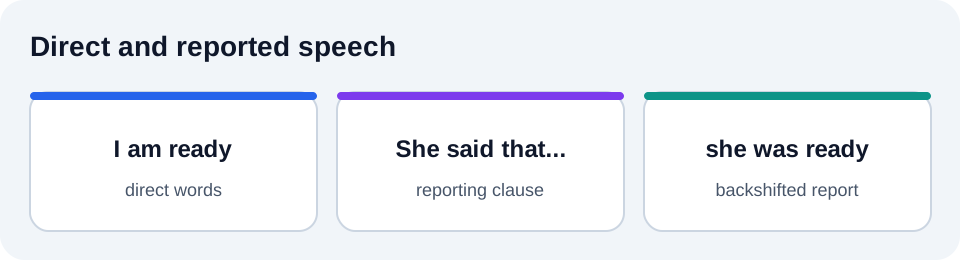
Reported speech (indirect speech) has one core rule: when you report what someone said, the tense moves one step back into the past — present becomes past simple, will becomes would, present perfect becomes past perfect — and the words that anchor the moment (tomorrow, yesterday, here, this) shift to match the new viewpoint (the next day, the day before, there, that). Questions lose their question word order, commands become to-infinitives, and say becomes tell when you mention the listener.
The 30 sentences below move from warm-up backshifts to the tricky cases — reported questions, requests, and the modals that stay the same. Every click is checked instantly with a one-line explanation of the rule, so a wrong answer turns into a rule you keep.
Reported Speech Quiz: 30 Questions
Warm-up · the basic tense backshift
Core · questions, requests and say vs tell
Challenge · the cases that trick everyone
Answer key and explanationsOpen after you finish the quiz.
- 1. wasPresent simple backshifts to past simple in reported speech: am → was. The reporting verb said (past) is what pulls the tense one step back.
- 2. workedPresent simple → past simple: work → worked. The shift happens because the reporting verb (said) is in the past.
- 3. were watchingPresent continuous backshifts to past continuous: are watching → were watching. Each tense moves exactly one step into the past.
- 4. had finishedPresent perfect backshifts to past perfect: have finished → had finished. Past perfect is the furthest back English can go.
- 5. wouldWill backshifts to would: I will call → she would call. The modal is what carries the tense shift in the result clause.
- 6. had seenPast simple backshifts to past perfect: saw → had seen. Yesterday becomes the day before, and the verb follows the same one-step rule.
- 7. couldCan backshifts to could. The same one-step pattern covers may → might and will → would; only a handful of modals resist the shift.
- 8. had livedPast simple → past perfect: had lived. In everyday speech the past simple is often kept when the order of events is already clear (He said they lived in Rome before moving to Naples), but have lived is wrong: a present perfect cannot follow a past reporting verb for a finished period.
- 9. had toMust (obligation) backshifts to had to, because must has no past form. Now shifts to then at the same time.
- 10. to closeCommands are reported with tell + object + to-infinitive: told us to close. The imperative form disappears — the to carries the instruction.
- 11. therePlace words shift with the viewpoint: here → there because the speaker is no longer in that place. Tomorrow → the next day for the same reason.
- 12. livedReported questions drop do-support and backshift: where do you live → where I lived. Word order becomes statement order — no do anywhere.
- 13. if I wasYes/no questions are reported with if or whether plus statement word order, and the tense backshifts: are you coming → if I was coming.
- 14. not to touchNegative commands are reported with not to + infinitive: warned me not to touch. The negation moves in front of to.
- 15. toldTell takes a personal object directly: told me that… Say needs to before the person (said to me), and speak/talk cannot take a that-clause.
- 16. askedRequests are reported with ask + object + to-infinitive: asked me to help. Said cannot connect to an object-and-infinitive pattern.
- 17. mightMay backshifts to might, exactly as will → would and can → could. One step back applies to modal verbs too.
- 18. thatThis → that in reported speech because the moment of speaking has moved. Pairs to memorize: this/that, today/that day, these/those.
- 19. had been waitingPresent perfect continuous backshifts to past perfect continuous: have been waiting → had been waiting. The one-step rule reaches continuous forms too.
- 20. he was doingReported wh-questions use statement word order (he was doing, not was he doing) plus backshift: are → was.
- 21. wereUnreal if-clauses in the second conditional do not backshift: if I were you stays if she were me. Backshifting to had been would turn it into advice about a past situation.
- 22. shouldShould has no other past form and does not backshift — he said I should see a doctor. Would, could, might and should all stay unchanged.
- 23. usedUsed to already describes the past, so it does not backshift: he used to smoke. Had used to is not standard English.
- 24. would be leavingFuture continuous backshifts to would be leaving, the same one-step rule that turns will into would — the continuous just comes along with it.
- 25. to openA polite request with could you is reported as ask + object + to-infinitive: asked me to open. The could disappears — it was politeness, not tense.
- 26. she … myPronouns shift to the reporter’s viewpoint: I → she and your → my, because she was speaking to me. Pronouns follow meaning, not a fixed table.
- 27. I hadWhether (or if) plus statement order: I had seen, not had I seen. And have seen backshifts to had seen — present perfect → past perfect.
- 28. suggestedSuggestions with let’s are reported with suggest + gerund: she suggested going. Tell and ask need an object, and said cannot link to -ing.
- 29. told himThe pattern is tell + object + not to + infinitive: told him not to be late. Said cannot take the personal object that this command needs.
- 30. goesWhen a statement is still universally true, the present tense stays: the Earth goes around the Sun. Backshift is for past reality, not for facts that have not changed.
The Backshift Rules in One Table
Reported speech runs on a single engine: if the reporting verb is in the past (said, told, asked, warned), every tense and most modals in the original sentence move one step further into the past. Learn the pairs below and the 30 questions above become pattern matching instead of guesswork.
- present simple → past simple: “I work” → she said she worked.
- present continuous → past continuous: “I am leaving” → he said he was leaving.
- present perfect → past perfect: “I have finished” → she said she had finished.
- past simple → past perfect: “I saw it” → he said he had seen it.
- will → would, can → could, may → might: “I will help” → she said she would help.
- must (obligation) → had to (must can also stay unchanged); would, could, might, should, and used to stay as they are.
If the reporting verb is in the present (she says…, he has just told me…), nothing backshifts: She says she is tired. The backshift is triggered by the past reporting verb, not by the past meaning.
When the Backshift Is Optional
Backshifting is the default after a past reporting verb, and it is never wrong. When the content is still true at the moment you report it, you may also keep the original tense: She said the office is closed on Fridays (it still is). Both versions are correct; keeping the present stresses that the information still applies.
Present-for-future plans follow the same one-step rule. “I fly to Madrid tomorrow” becomes She said she was flying to Madrid the next day: the reported version uses the past continuous, the normal way to report a fixed plan. She said she flew the next day sounds odd.
Time and Place Words That Shift With the Viewpoint
The tense is only half the job. Words that point at the original moment of speaking must move too, because the reporter is standing at a new point in time and (often) in a new place. If you report something on the same day, in the same place, these words can stay: She said she'd be here at five.
- now → then / at that moment.
- today → that day; tonight → that night.
- tomorrow → the next day / the following day.
- yesterday → the day before / the previous day.
- next week → the following week; last week → the week before.
- here → there; this → that; these → those; come → go (when the reporter is elsewhere).
Say vs. Tell — and Choosing the Right Reporting Verb
A very common reported-speech error is say with a personal object (He said me that…). The split is mechanical: tell takes the listener directly (tell me, tell him, tell us), while say needs to before a person (say to me) or takes no person at all.
- tell + object + (that) / to-infinitive: He told me (that) he was ill. She told us to wait.
- say + (that): He said (that) he was ill — never said me.
- ask + object + to-infinitive (requests): She asked me to open the window.
- warn / advise / remind + object + to-infinitive: He reminded me not to be late.
- suggest + gerund: She suggested going for a walk — never suggested me to go.
Reporting Verbs Beyond Said — and the Pattern Each One Takes
Said reports the words but not the tone. In summaries, minutes, and essays, a more precise verb tells the reader what kind of statement it was. The catch is that each verb comes with its own grammar, so learn it with its pattern.
- + that-clause: stated, explained, mentioned, insisted, claimed, complained, replied, confirmed, added — He insisted that he had paid. She replied that she was on her way.
- + -ing: admitted, denied, suggested, recommended — He admitted making the mistake. She denied seeing the email. (admit, deny, and suggest also take a that-clause.)
- + to-infinitive: promised, agreed, offered, refused, threatened — She promised to call back. He refused to sign.
- + object + to-infinitive: told, asked, advised, reminded, warned, encouraged — The doctor advised him to rest. She reminded us to lock up.
- Tone: claimed suggests the statement may not be true; insisted suggests the speaker was being challenged; mentioned makes the point sound minor.
Reporting Questions and Commands: Kill the Question Order
Reported questions are the biggest structural trap, because the grammar of the sentence must change shape, not just the tense. Direct questions use question word order with do/does/did; reported questions use statement order and drop the auxiliary entirely. Commands skip the clause stage altogether and compress into to-infinitives.
- “Where do you live?” → He asked me where I lived. (no do, no inversion)
- “Are you ready?” → She asked if I was ready. (yes/no → if/whether)
- “Stand up,” the coach said → The coach told us to stand up.
- “Don’t panic,” she said → She told us not to panic.
Test every reported question with this question: could I put a full stop where the question mark was? If the order still sounds like a question (asked me where did I live), it is wrong.
Where Reported-Speech Errors Come From
Reported speech asks you to rebuild a sentence from a new viewpoint, and under time pressure writers copy the surface instead: they keep the original tense (he said he will come), the original pronouns (she said I like your shoes), or the question order (he asked where do I live).
Your first language decides which shortcut is most tempting. Russian keeps the tense of the original words (Он сказал, что работает дома — literally he said that he works at home), and Japanese, Chinese, and Indonesian do not backshift either, so English backshift feels like an extra rule and gets dropped first. Chinese and Japanese form yes/no questions with a particle (吗, か), so if/whether + statement order has no counterpart. Spanish, French, and Italian speakers usually backshift correctly, because their languages do it too, but carry over decir/dire + person and write he said me.
When you write he said…, run a three-point check: tense back one step, pronouns from the reporter’s side, time and place words updated. Most reported-speech errors hide in one of those three spots.
Practice With Real Quotes
Practise with real material. Take a news article with several direct quotes and rewrite three of them in reported speech: one statement with said, one with a more precise reporting verb from the list above, and one question. Then do the same with two sentences from an email you received this week, as if you were summarising it for a colleague.
Paste your versions into PromGee’s free grammar checker. It flags backshift, pronoun, and time-word slips and explains the rule it applied.
Reporting verbs carry different patterns
Say that introduces words; tell someone that names the recipient; ask someone to do something reports a request; explain something to someone does not take the same double-object pattern as tell. Compare “She said that the invoice was wrong”, “She told me that the invoice was wrong”, and “She asked me to check the invoice”. Backshift depends on the reporting context; a fact that is still true can stay in the present.
Keep practicing
Frequently Asked Questions
What is the rule for reported speech in English?
When the reporting verb is past (said, told, asked), the tense moves one step back: present → past simple, will → would, present perfect → past perfect. Time and place words shift too (tomorrow → the next day, here → there), and questions change to statement word order.
When do you not change the tense in reported speech?
The tense does not change when the reporting verb is present (she says she is tired), or with would, could, might, should, and used to, which are already past forms or have no further past form. When the statement is still true, you may keep the original tense (she said the Earth goes around the Sun), although backshifting is also correct.
What is the difference between 'say' and 'tell'?
Tell takes the listener directly with no preposition: he told me (that) he was ill. Say takes no personal object, or needs to: he said (that) he was ill, or he said to me that… Never write said me or told that without a person after told.
Fix Reported Speech Mistakes in Your Own Writing
Paste any text into PromGee’s free grammar checker and see each reported-speech slip explained in plain language.
Check My Writing Free