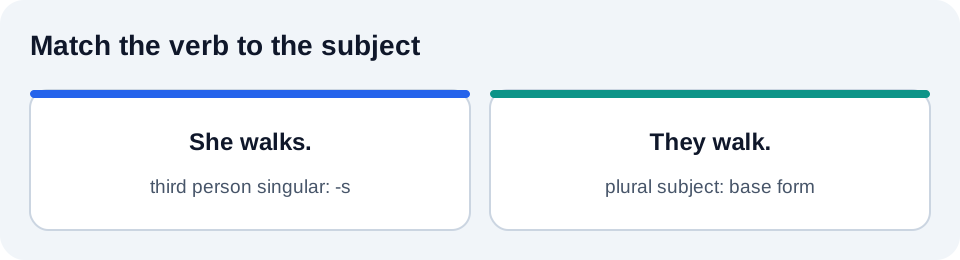
Subject-verb agreement has one core rule: the verb agrees with the true grammatical subject in number, not with the noun that happens to sit closest to it. The traps all work the same way — they insert a plural-looking word between the real subject and the verb (each of the students has, one of my friends lives, the number of accidents has fallen), or they use subjects whose number is not what it looks like (news, mathematics, ten dollars, everybody).
The 30 sentences below are sorted from warm-up to challenge and are the exact patterns that trip native speakers as often as learners. Every answer is checked on the spot with a one-line explanation, so each miss teaches you the rule instead of just the answer.
Subject-Verb Agreement Quiz: 30 Questions
Warm-up · the rules that decide most sentences
Core · nearest subject, amounts and proportions
Challenge · the sentences that trick native speakers too
Answer key and explanationsOpen after you finish the quiz.
- 1. isIn formal written English, neither of + plural noun normally takes a singular verb: neither of the answers is correct. Plural agreement is common in informal speech; this question explicitly asks for the formal form.
- 2. areStrip the modifier: the subject is books, not shelf. The plural noun before the verb — not the one inside the phrase — controls the agreement.
- 3. areBrother and sister refer to two separate people, so use are. Subjects joined by and usually take a plural verb, but a single combined item or expressions with each/every can take singular agreement.
- 4. hasEach is singular no matter what follows it: each of the students has. Every, either, and neither behave the same way.
- 5. isNews looks plural but is an uncountable singular noun: the news is. The -s is historical, not a plural marker.
- 6. isA distance, amount, or sum of money treated as one unit takes a singular verb: ten kilometers is a long way. The measurement is one block, not ten separate items.
- 7. isEverybody, everyone, somebody, nobody, and everything are grammatically singular: everybody is. The prepositional phrase in the office describes everybody but does not change its number.
- 8. isSubjects ending in -ics — mathematics, physics, economics, politics — take a singular verb when they name a field of study: mathematics is.
- 9. livesThe subject is one, not friends: one of my friends lives. The of-phrase is a modifier, and one always takes a singular verb.
- 10. areIn there is/are sentences, the real subject comes after the verb: several reasons → there are. Find the true subject first, then choose the verb.
- 11. isThe subject is pair (singular), not shoes: the pair is out of stock. A pair of is a single unit even though it contains two.
- 12. areWith neither…nor (and either…or), the verb agrees with the nearer subject: employees → are. Proximity, not logic, decides here.
- 13. isSame rule, flipped: the nearer subject is now manager, so the verb is singular — the manager is responsible. Swap the subjects and the verb swaps with them.
- 14. areA number of means several and takes a plural verb: a number of students are. It describes the students; it does not count them.
- 15. hasThe number of means the total count and takes a singular verb: the number has fallen. A number of = plural; the number of = singular.
- 16. arePlural-form nouns such as glasses, scissors, trousers, and jeans normally take a plural verb: the glasses are new. With a pair of, the head noun pair is singular: this pair of glasses is new.
- 17. isFractions and percentages agree with the noun that follows: half of the pizza (singular) is. Compare half of the students (plural), which takes are.
- 18. areProportions copy the noun: half of the students (plural) are absent. The fraction word is irrelevant — the noun decides.
- 19. wasEvery before a list keeps the subject singular: every man, woman, and child was. The and in the list does not make the subject plural, because every applies to each person separately.
- 20. isA sum of money is a single amount: ten dollars is too much. Money, time, and distance take singular verbs when treated as one unit.
- 21. areLike there is/are, here sentences put the real subject after the verb: the documents are here. Here comes the bus (singular) vs here are the documents.
- 22. isAlong with, as well as, together with, and in addition to do not create a compound subject — the verb agrees with the captain: is.
- 23. areNearest-subject rule again: rolls is closer to the verb, so the verb is plural — the rolls are fresh. Reversing the nouns would flip the verb.
- 24. doesAs a field of study, economics is singular: economics does not require. In other senses (his personal economics are shaky) the plural can appear — context decides.
- 25. isThe head noun is series (singular): a series is scheduled. Kind of, type of, portion of, and series of all follow their own head noun.
- 26. has beenTwo-thirds agrees with vote, which is uncountable here (one body of votes): two-thirds of the vote has been counted. Two-thirds of the voters have been counted.
- 27. meetsNot one is emphatically singular: not one of the applicants meets. The plural applicants is a distraction inserted exactly where your eye lands.
- 28. hasEach and every doubles the emphasis but keeps the subject singular: each and every answer has. Combined singulars never become plural.
- 29. workThe relative pronoun who refers to employees (plural), so the clause verb is plural: employees who work weekends. He is the only one — but who points at the group.
- 30. isThe fixed pattern more than one takes a singular verb, even though it logically describes a plural: there is more than one reason. English counts the one.
Find the Real Subject First
Every subject-verb agreement question reduces to a single move: find the true grammatical subject, ignore everything between it and the verb, and match the verb to it. The traps are not different rules — they are all distractions placed between the subject and the verb, counting on your eye to grab the nearest noun instead.
- Strip prepositional phrases: the books on the top shelf are… → subject = books.
- Strip of-phrases: each of the students has… one of my friends lives… → subject = each / one.
- Ignore interruptions: the captain, along with his players, is… → subject = the captain.
- There is / here is: the subject comes after the verb — there are several reasons.
Draw an arrow from the verb to the word it agrees with before you choose the form. In tested sentences, that word is almost never the noun immediately to the left of the verb.
Words That Look Plural but Take a Singular Verb
English has a shelf of nouns and pronouns whose number is not what it looks like. The -s on news, mathematics, physics, and economics is historical, not plural. Indefinite pronouns ending in -body, -one, and -thing are grammatically singular even though they refer to many people. And quantities — ten kilometers, ten dollars, three hours — describe one unit when the amount is treated as a block.
- Uncountable singulars: news, information, advice, furniture, luggage → the news is good.
- Fields of study in -ics: mathematics, physics, economics, politics → physics is hard.
- Indefinite pronouns: everybody is, nobody knows, something smells great.
- Units and sums: ten dollars is, five miles is, three hours feels long.
- Plural-only nouns are the reverse trap: glasses are, scissors are, trousers are.
Either/Or and Neither/Nor: The Verb Follows the Nearest Subject
When two subjects are joined by or, nor, either…or, or neither…nor, the verb agrees with the one closer to it. Neither the manager nor the employees are… but neither the employees nor the manager is…. The sentence can be grammatically correct with either a singular or a plural verb — the nouns decide, not the logic.
A practical writing tip follows directly: put the plural noun second when you want the smoother plural verb, and never mix in along with or as well as expecting the same effect — those phrases do not create a compound subject, and the verb stays with the first noun.
- or / nor / either…or / neither…nor → agree with the nearest subject.
- and → usually plural; a compound understood as one unit, or an every/each construction, can take singular agreement.
- along with / as well as / together with → no effect; verb agrees with the first subject.
- Not only the employees but also the manager was notified — nearest wins again.
A Number of vs. The Number of — and Other Amount Traps
The famous pair works like this: a number of means several and behaves like a plural (a number of students are waiting), while the number of names the count itself and is singular (the number of students has doubled). The same logic extends to fractions and percentages, which copy the noun they modify: half of the pizza is, half of the students are, two-thirds of the vote has been counted, two-thirds of the voters have been counted.
Collective nouns — team, committee, staff, family — are the grey zone: American English usually treats them as singular (the team is winning), while British English allows plural when the members act individually. In international and exam writing, the singular is the safe default, and the plural is reserved for cases where division is the point (the committee are divided).
Test amounts with one question: is the quantity one block (singular verb) or a set of individuals (plural verb)? Ten dollars is one block; ten coins are ten objects.
Why Agreement Goes Wrong: The Nearest Noun Pulls the Verb
Psycholinguists call the core error agreement attraction: while you build a sentence, a plural noun sitting just before the verb pulls the verb into the plural, even though you know the real subject is singular. That is why 'each of the answers are' feels right as you write it and wrong when you reread it. Native speakers make this slip too, especially in long, unedited sentences.
Your first language adds its own pull. Chinese, Japanese, Indonesian, and Thai verbs do not change for number at all, so every English -s needs a conscious decision and is easy to drop (she work, the price increase). Spanish uses one invariable form for there is/there are (hay muchas razones), which produces there is many reasons; Standard Arabic puts a singular verb before a plural subject (literally came the students), with the same effect.
Collective nouns pull the other way. Spanish and Italian la gente takes a singular verb (la gente es, la gente è), so speakers of those languages often write people is; in English, people is plural (people are). Police works the same way: la policía es, but the police are investigating.
In anything you submit or send, search for the trigger words — each, every, neither, one of, a number of, the number of, there — and check the verb after each one. That 30-second scan catches most agreement errors.
How to Practice Agreement So It Becomes Automatic
Agreement is a spotting skill before it is a choosing skill. After the quiz, take one page of your own writing and underline the subject of every verb before you check the verb form. Long subjects (the cost of the new laptops for the sales team) are where errors hide, so start with those.
For a second check, paste a recent email, essay, or report into PromGee’s free grammar checker. It flags agreement errors, shows the subject it found, and explains the rule.
Keep practicing
Frequently Asked Questions
What is the basic rule for subject-verb agreement in English?
A singular subject takes a singular verb and a plural subject takes a plural verb — but the verb agrees with the true grammatical subject, not the noun nearest to it. In Each of the students has a locker, the subject is each (singular), so the verb is has.
Does 'neither of them' take 'is' or 'are'?
In careful written English, neither of them is — neither is grammatically singular even though it refers to two people. The same applies to either of, each of, and every one of. Informal speech often uses are, but exams and edited writing expect the singular.
Why do 'a number of' and 'the number of' take different verbs?
A number of means several and behaves as plural: a number of students are waiting. The number of names the count itself and is singular: the number of students has doubled. The article changes the meaning — and the verb follows the meaning.
Catch Agreement Errors in Your Own Drafts
Paste any email, essay, or report into PromGee’s free grammar checker and see each subject-verb decision explained.
Check My Writing Free