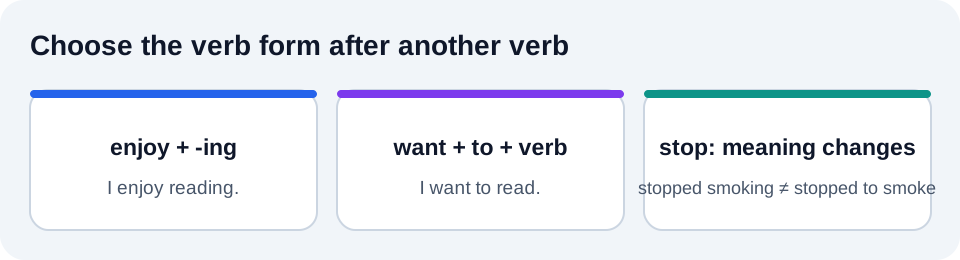
There is no rule that predicts, for every verb, whether it takes a gerund (-ing) or an infinitive (to + verb). The system has two halves. For most verbs the pattern is simply fixed and has to be learned with the verb: enjoy, avoid, suggest, and every preposition take a gerund, while decide, hope, refuse, and many verbs of intention take to + infinitive. For a short list of verbs (stop, remember, forget, regret, try, mean, go on) both forms are possible but mean different things.
The 30 exercises below are sorted from warm-up to challenge and cover both halves, including let, make, and help with the bare infinitive. Every answer is checked instantly with a one-line explanation of the rule, so each miss teaches you the pattern rather than just the answer.
Gerund or Infinitive Quiz: 30 Questions
Warm-up · fixed patterns: -ing or to?
Core · verb + object patterns and bare infinitives
Challenge · meaning changes and fixed expressions
Answer key and explanationsOpen after you finish the quiz.
- 1. listeningEnjoy takes a gerund complement: enjoy listening. Do not generalize this to all verbs of liking: love and like can take either a gerund or a to-infinitive, depending on context.
- 2. to buyDecide is always followed by the to-infinitive: decide to do. Verbs of choice and intention — decide, hope, refuse, agree — take to.
- 3. to goAfford takes the to-infinitive: can’t afford to go. Learn it with the infinitive verbs like manage and decide.
- 4. answeringAvoid is always followed by a gerund: avoid doing. Never avoid to do — this is one of the most common learner errors.
- 5. to hearHope takes the to-infinitive: hope to hear. The fixed phrase in every formal sign-off is looking forward to hearing — the -ing belongs to looking forward to, not to hope.
- 6. openingMind takes a gerund: would you mind opening. The same pattern appears in the reply: I don’t mind waiting.
- 7. to signRefuse is always followed by the to-infinitive: refused to sign. Like agree and promise, it points forward to an intended action.
- 8. readingFinish takes a gerund: finished reading. So do the other verbs about the course of an activity: keep, carry on, give up, quit.
- 9. to postponeAgree takes the to-infinitive: agreed to postpone. Note the difference from suggest, which takes a gerund for the same idea: They suggested postponing the meeting.
- 10. talkingKeep takes a gerund: kept talking. Keep doing means continue the activity, and continuing verbs — keep, carry on, go on — take -ing.
- 11. to bePromise takes a to-infinitive when describing what the subject undertakes to do: He promised to be on time. With a recipient, a clear construction is He promised her that he would be on time.
- 12. to beTell + object takes the to-infinitive: told us to be. Commands reported directly use tell someone to do something.
- 13. to knowIn want + object + action, use the to-infinitive: I want you to know. In informal British usage, want can also mean need with an -ing form, as in The grass wants cutting; that is a different construction.
- 14. stayLet takes the bare infinitive — no to: let me stay. Let, make, and have (causative) are the three great bare-infinitive verbs.
- 15. tidyMake + object takes the bare infinitive: made her son tidy. In the passive, to returns: he was made to tidy his room.
- 16. drinkingStop + gerund means quit the activity: stopped drinking coffee. Stop to drink would mean pause in order to drink — the opposite of the sentence’s meaning.
- 17. to buyStop + to-infinitive means stop in order to do something: stopped to buy petrol. Here the to-infinitive is a purpose clause, the same to as in I came to help.
- 18. to lockForget + to-infinitive means fail to do a task: don’t forget to lock. The task is still ahead of you, and future tasks take to.
- 19. visitingForget + gerund means lose the memory of a past experience: never forget visiting. Past memories take -ing; future tasks take to.
- 20. to bringRemember + to-infinitive means not forget an obligation: remember to bring. Remember bringing would describe recalling a past action.
- 21. solvingAfter a preposition, a verb takes the gerund: good at solving. The same goes for at, in, about, for, of, without, before, and after.
- 22. meetingThe to in look forward to is a preposition, not part of an infinitive — so it takes a gerund: looking forward to meeting. Same for be used to and object to.
- 23. learningInterested in + gerund: the preposition in forces -ing. Other adjective + preposition pairs behave the same way: afraid of flying, tired of waiting, keen on cooking.
- 24. to tellRegret + to-infinitive introduces formal bad news: I regret to tell you… It means I am sorry as I do it — the announcement is happening now.
- 25. sendingRegret + gerund expresses remorse about a past action: regret sending. The email already went out, and finished actions take -ing.
- 26. to callMean (intend) takes the to-infinitive: meant to call. The intention pointed forward; the gerund form — mean calling — does not exist in this sense.
- 27. cryingIt’s no use takes a gerund: it’s no use crying. The same fixed pattern appears in it’s no good arguing and there’s no denying.
- 28. worryingNo point in + gerund: there’s no point in worrying. After the preposition in, only the -ing form is grammatical.
- 29. stayWould rather takes the bare infinitive: I’d rather stay. Like would rather, had better also drops the to — you’d better hurry.
- 30. drivingBe used to (be accustomed to) takes a gerund: used to driving. Compare the different pattern used to do (past habit): she used to drive a van.
The Verb Patterns in One Table
Most verbs allow only one pattern, and they fall into a few families: verbs that take a gerund, verbs that take a to-infinitive, verbs that take an object plus an infinitive, and a handful that take either.
Meaning gives you a useful hint: the to-infinitive often points forward to something wanted or planned (decide to go, hope to see), while the gerund often names an activity as a whole (enjoy swimming, finish writing). But the hint does not predict individual verbs. Consider, postpone, and risk look forward and still take -ing (consider moving, postpone signing). So use meaning to understand the pairs that change meaning, and learn every other verb together with its pattern.
- Gerund verbs: enjoy, avoid, suggest, finish, keep, mind, practise, consider, postpone, risk, deny, admit, can’t stand, it’s no use, it’s worth, can’t help.
- Infinitive verbs: decide, hope, refuse, agree, promise, afford, manage, offer, plan, want, seem, learn, need.
- Object + to-infinitive: tell, ask, want, remind, warn, advise + someone to do.
- Bare infinitive: let, make, have + someone do — and would rather, had better + do.
- Either form, little or no change in meaning: like, love, hate, prefer, start, begin, continue (I like swimming / I like to swim; it started raining / it started to rain).
- Prepositions take a gerund: good at solving, interested in learning, without asking.
With start, begin, and continue, English avoids two -ing forms in a row: It’s starting to rain, not It’s starting raining.
Verbs That Change Meaning: stop, remember, forget, regret, try, mean, go on
A short list of verbs accepts both forms and shifts meaning between them. Here the forward/backward hint really works: the to-infinitive points to an action still ahead, while the gerund refers to an activity that is already happening or already done. Stop drinking = quit the habit; stop to drink = pause in order to drink. Remember to lock = don’t neglect the task; remember locking = recall the past act. Regret to tell = formal bad-news formula; regret telling = remorse about what you did.
These pairs matter more than the rest of the topic, because the wrong form changes what you say instead of just sounding odd. With remember, forget, and regret, ask: is the action already done (-ing) or still to be done (to)? Try and go on need their own definitions, below.
- stop to smoke (pause in order to) vs stop smoking (quit).
- remember to post (task ahead) vs remember posting (past memory).
- forget to bring (fail to do) vs never forget visiting (past experience).
- regret to inform (formal announcement) vs regret informing (remorse).
- try to open (attempt hard) vs try opening (experiment with an alternative).
- mean to call (intend) vs it means waiting longer (involve, have as a result).
- went on talking (continued the same activity) vs went on to explain (moved to the next thing).
The Bare Infinitive: Let, Make, Help — Where To Disappears
After let and make, English drops the to entirely: let me go, made him apologize. Learners over-apply the to-rule here because most object verbs (want you to know, told us to wait) need it. The passive flips the pattern — he was made to apologize — and the ordinary permission sense of let is usually expressed in the passive with be allowed to: we were allowed to stay. Help is the odd one out, accepting both: help me carry it and help me to carry it are both correct. Other expressions, such as he was let go, have separate uses.
Two fixed expressions behave the same way: would rather (I’d rather stay) and had better (you’d better leave). If you can insert a silent to and the sentence breaks, the verb is one of the bare ones.
Test: my boss made me ___ the report again. Both to rewrite and rewrite sound familiar, but make + object takes the bare infinitive — made me rewrite.
The Most Reliable Rule in the Topic: Prepositions Take -ing
If a preposition (at, in, on, of, for, about, without, before, after) sits in front of the verb, the verb is a gerund: interested in learning, without asking, before leaving, good at listening. (The only exceptions are but and except meaning other than, which take a bare infinitive: He did nothing but complain.) The trap is the to in look forward to, be used to, object to, admit to — a preposition that looks like an infinitive marker.
That fake to is why I look forward to hear from you is wrong in thousands of cover letters. The test: can you put a noun after the to? Look forward to the meeting works — so to is a preposition, and the verb must take its gerund shape: look forward to hearing.
Where the Wrong Form Comes From
Spanish, Italian, French, and Portuguese use the infinitive in places where English needs -ing. After a preposition they say antes de salir, prima di partire, avant de partir — so learners write before to leave or before leave instead of before leaving. The same languages use the infinitive as a subject (Fumar es malo), which produces To smoke is bad or Smoke is bad where everyday English says Smoking is bad.
German speakers meet the same trap with zu: Ich freue mich darauf, dich zu sehen becomes I look forward to see you. Because German zu and English to both feel like infinitive markers, the preposition to in look forward to is easy to miss.
Chinese, Japanese, Korean, and Indonesian do not have a gerund/infinitive choice in the English sense, so speakers often reach for the bare verb (I enjoy swim, I decided go) or pick one form and use it everywhere. For them the choice really is new information, and it has to be learned verb by verb.
Learn verbs in the phrase, never alone: enjoy doing, decide to do, avoid answering, afford to go. Then you recall the pattern with the verb instead of deciding it each time.
Next Steps With Verb Patterns
Keep the two halves separate. For the fixed patterns, make a two-column list (verb + -ing, verb + to) of only the verbs you actually got wrong above, and quiz yourself from it before you write. For the meaning-changers, write a pair of sentences about your own life for each verb: I remember meeting my manager for the first time / I must remember to send her the report.
Then let your own writing be the exercise. Paste an email or essay into PromGee’s free grammar checker and each gerund/infinitive slip is flagged with the correct pattern.
Start, stop and the limits of meaning shortcuts
Both “It started raining” and “It started to rain” are standard. By contrast, “I stopped smoking” means I gave up the activity, while “I stopped to smoke” means I paused another activity in order to smoke. Learn the pattern of the actual verb; categories such as “future intention” do not predict every complement.
Keep practicing
Frequently Asked Questions
How do I know when to use a gerund or an infinitive in English?
Mostly by learning each verb’s pattern: enjoy, avoid, suggest, finish and all prepositions take a gerund (-ing), while decide, hope, refuse, agree, and want take to + infinitive. A short list — stop, remember, forget, regret, try, mean, go on — takes both with a change of meaning, and like, love, hate, start, and begin take both with little or no change.
Which verbs are followed by a gerund and which by an infinitive?
Gerund verbs include enjoy, avoid, keep, mind, finish, practise, can’t stand, suggest, and it’s no use. Infinitive verbs include decide, hope, refuse, agree, promise, afford, manage, offer, plan, and want. Learn each verb with its pattern as one phrase — enjoy doing, decide to do — rather than as two separate facts.
Why do 'stop to smoke' and 'stop smoking' mean different things?
Stop + gerund means quit the activity: stop smoking = don’t smoke anymore. Stop + to-infinitive means pause one action in order to do another: stop to smoke = take a break in order to have a cigarette. The to-form points forward to the next action; the -ing form looks back at the one being interrupted.
Lock In the Right Pattern in Your Own Writing
Patterns stick fastest on text you actually wrote. Paste any email or essay into PromGee’s free grammar checker and get each gerund/infinitive choice explained in plain language.
Check My Writing Free