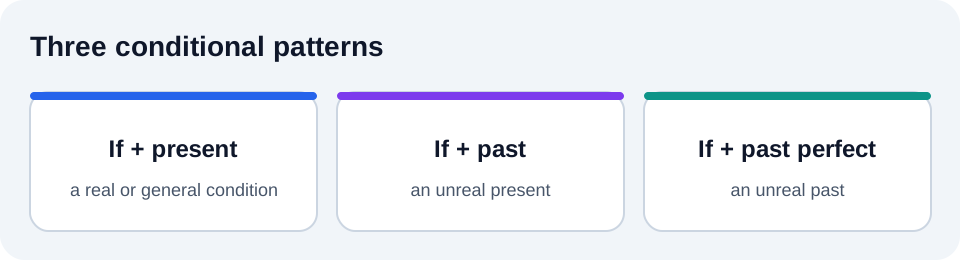
A conditional sentence has two halves: the condition (the if-clause) and the result (the main clause). The type of conditional depends on one question: how real is this situation, and when does it apply? Real situations use normal tenses. Unreal situations “step back” one tense. That single idea explains all five types.
The Big Idea: Real vs Unreal
Every conditional is a combination of two decisions: is the condition real or unreal? and is the time present/future or past? The tense in each half follows directly.
| Type | Real or unreal? | Time | Formula |
|---|---|---|---|
| Zero | Real | Always / general truth | If + present, present |
| First | Real | Future | If + present, will + verb |
| Second | Unreal | Present / future | If + past, would + verb |
| Third | Unreal | Past | If + past perfect, would have + p.p. |
| Mixed | Unreal | Past condition + present result | If + past perfect, would + verb |
Zero Conditional: Facts & Habits
Formula: If + present simple, present simple
The zero conditional states scientific facts, general truths, and personal habits — things that are always true when the condition is met. There is no “will” here, because nothing is being predicted; it is a simple cause and effect.
When can replace if here without changing the meaning: When you heat ice, it melts. That is the fastest way to recognize a zero conditional — the sentence states an automatic result, not a possibility.
First Conditional: Real Future Possibilities
Formula: If + present simple, will + base verb
The first conditional describes real, possible future situations — the ones that can genuinely happen. The if-clause stays in the present tense even though it refers to the future; will appears only in the result clause.
Never put will in the if-clause: If it will rain, we will cancel. → If it rains, we will cancel. The if-clause uses the present tense.
Second Conditional: Unreal Present & Hypotheticals
Formula: If + past simple, would + base verb
The second conditional describes unreal or unlikely present situations, imaginary worlds, and advice. Because the situation is imaginary, the tense steps back to the past — even though you are talking about now.
The most famous use is giving advice: If I were you, I would… Note the subjunctive were for all persons — more on that in Section 7. This conditional is also the polite way to talk about unlikely dreams: If I won the lottery, I would quit my job.
Third Conditional: Unreal Past & Regret
Formula: If + past perfect, would have + past participle
The third conditional talks about the past that cannot be changed. Use it for regret, missed opportunities, and imagining different outcomes of things that already happened.
Notice the double past: had studied (past perfect) in the condition, would have passed in the result. Both halves reach back in time because the whole situation lives in the past.
Mixed Conditionals
Mixed conditionals break the “same time in both halves” rule. The most common mix is a past condition with a present result: the condition happened (or didn’t) in the past, and the consequence is visible now.
Formula: If + past perfect, would + base verb
The trick to spotting a mixed conditional: the if-clause is third-conditional (past perfect) but the result clause is second-conditional (would + verb, no “have”). Mixed conditionals show up in advanced exams and in natural business English when people explain how the past shapes the present.
If I Was vs If I Were
In unreal situations (second and mixed conditionals), the subjunctive form were is preferred for all subjects: I were, she were, it were. The subjunctive signals clearly that the situation is hypothetical.
Test: if the sentence is imaginary, use were. If it is a factual statement about the past, use was. In formal writing and all exams, if I were is the safe choice for hypotheticals.
Common Mistakes
Test Yourself
Complete each sentence with the correct form, then check the answers. State which conditional type you used.
1. If you ___ (freeze) water, it ___ (turn) into ice.
Answer: freeze / turns — zero conditional, general truth.
2. If we ___ (miss) the train, we ___ (be) late.
Answer: miss / will be — first conditional, real future possibility.
3. If I ___ (win) the lottery, I ___ (buy) a house.
Answer: won / would buy — second conditional, unreal present.
4. If they ___ (arrive) on time, the meeting ___ (start) at 9.
Answer: had arrived / would have started — third conditional, unreal past.
5. If I ___ (not / break) my laptop, I ___ (work) from home now.
Answer: hadn’t broken / would work — mixed conditional, past condition + present result.
6. If I ___ (be) you, I ___ (accept) the offer.
Answer: were / would accept — second conditional with subjunctive were.
How to Make Conditionals Automatic
Conditionals are formula-driven, which makes them perfect for active drilling. Write each of the five formulas on a card, then generate your own sentence for each one — not a memorized example, a sentence about your real life. Generating your own examples forces the tense logic through your own production system.
PromGee’s grammar and tenses categories include focused conditionals practice: you get a scenario and must choose the correct conditional type and tense, with AI explanations of why the other types would change the meaning. That is exactly the retrieval practice that builds automaticity.
Before your next exam or business email, run a quick self-test: take one regret, one dream, and one plan, and express each as a third, second, and first conditional. If you can do all three accurately, you have internalized the system.
Real situations use real tenses: zero (facts) = if + present, present; first (future) = if + present, will. Unreal situations step back one tense: second (hypothetical present) = if + past, would; third (past regret) = if + past perfect, would have + p.p.; mixed = past condition + present result. Use “if I were” for hypotheticals. Never put would or will in the if-clause.