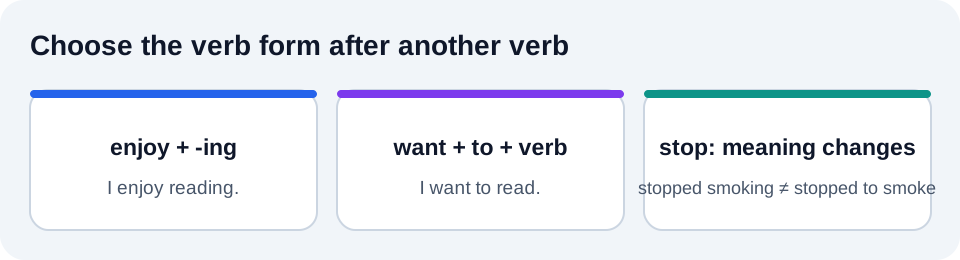
When one verb is followed by another verb, English forces you to choose between the -ing form (a gerund) and the to + verb form (an infinitive): I enjoy cooking vs I decided to cook. Languages that rely on a single conjugated pattern for both make this choice feel arbitrary. It is not. English verbs group into a small number of patterns, and once you see the groups, the right form follows almost automatically.
The Core Difference
Gerund (-ing): the action seen as an activity, experience, or ongoing state.
Infinitive (to + verb): the action seen as a goal, purpose, or future intention.
Hold on to that contrast — activity/experience vs goal/purpose — because it explains the meaning-change pairs in Section 4. For the majority of verbs, though, you do not reason from meaning at all: you memorize which pattern each verb demands. The four buckets below organize that memorization so it is logical instead of chaotic.
Bucket 1: Liking & Disliking → Gerund
Verbs that express feelings, preferences, and attitudes about an activity are almost always followed by a gerund. When you like, enjoy, or avoid something, you are describing the experience of doing it — which is exactly the gerund’s territory.
enjoy · like · love · hate · dislike · don’t mind · can’t stand · avoid · keep · finish · quit · consider · suggest · imagine · practise · risk · miss · deny · admit
The classic error here is “I enjoy to cook”. Because enjoy always takes a gerund, the natural form is I enjoy cooking. Note that like, love, and hate are flexible — both forms work with little difference — but enjoy, avoid, finish, suggest, and consider are strictly gerund verbs.
Bucket 2: Future & Planning → Infinitive
Verbs about decisions, plans, promises, and intentions point forward at a goal. That forward direction is exactly what the infinitive expresses, which is why planning verbs demand to + verb.
want · hope · decide · plan · intend · expect · promise · agree · offer · refuse · manage · afford · seem · learn · need · forget · remember (future sense) · would like
The error pattern here mirrors Bucket 1 in reverse: learners say “I want buying” or “I decided going”. Because want and decide point at a future goal, the correct forms are I want to buy and I decided to go. When in doubt about a planning verb, ask: “Does this verb describe a decision or intention about a future action?” If yes, the infinitive is almost certainly correct.
Bucket 3: Meaning Changers
A small set of verbs change meaning depending on whether you use a gerund or an infinitive. These are the highest-value pairs to master because they appear in exams, in business English, and in everyday conversation — and getting them wrong changes what you actually say.
| Verb | Gerund → | Infinitive → |
|---|---|---|
| stop | finish the activity (She stopped smoking) | pause in order to (He stopped to rest) |
| try | experiment with a method (Try turning the key) | make an effort (I tried to open the jar) |
| remember | recall a past action (I remember locking the door) | not forget a future duty (Remember to lock the door) |
| forget | not recall a past action (I’ll never forget meeting her) | fail to do a future duty (Don’t forget to call) |
| regret | wish you had not done it (I regret leaving early) | announce bad news formally (We regret to inform you) |
| go on | continue the same activity (He went on talking) | move to a new topic (She went on to explain) |
| mean | involve (Taking the bus means walking more) | intend to (I mean to finish today) |
A reliable shortcut: remember, forget, and regret use the gerund when the action already happened (backward), and the infinitive when the action still needs to happen (forward). The gerund-infinitive difference is fundamentally a time-direction signal.
Bucket 4: Dual-Usage Verbs (Either Works)
These verbs accept both forms with only a small, subtle difference in nuance. In most cases both are correct and neither sounds wrong — a useful relief after the meaning changers.
| Verb | Gerund nuance | Infinitive nuance |
|---|---|---|
| like / love / hate | general preference, enjoyment of the experience | specific choice, preference stated as a goal |
| start / begin | common in continuous tenses (It’s starting raining) | neutral, equally correct (It started to rain) |
| continue / prefer | activity-focused | choice-focused |
| bother / intend | colloquial and common (Don’t bother cooking) | more formal (Don’t bother to cook) |
With these verbs, do not overthink. Native speakers freely switch between I like swimming and I like to swim. Choose whichever sounds smoother in your sentence; both are grammatically safe.
The Cheat Sheet
Copy this summary into your notes. It is the complete decision procedure for gerund vs infinitive, from subject position to fixed verbs.
1. As a subject or object of the sentence? Use the gerund. Swimming is fun · I love reading.
2. After a preposition? Always the gerund. Interested in learning · good at cooking · without asking.
3. Liking/disliking verb (enjoy, avoid, finish, suggest, consider, mind)? Use the gerund.
4. Planning/future verb (want, decide, hope, promise, plan, refuse, offer)? Use the infinitive.
5. A meaning-changer (stop, try, remember, forget, regret)? Check the time direction: past action → gerund; future goal → infinitive.
6. Anything else? Look up the verb once, note its pattern, and move on. Most verbs beyond these buckets follow the rules of buckets 1 and 2.
Common Mistakes
Test Yourself
Choose the correct form for each sentence, then check the answers below. Write your answer before revealing each one — retrieval beats re-reading.
1. I can’t stand ___ (wait) in long queues.
Answer: waiting — can’t stand is a liking/disliking verb (gerund).
2. She agreed ___ (help) us with the report.
Answer: to help — agree is a planning/decision verb (infinitive).
3. On my way home, I stopped ___ (buy) milk.
Answer: to buy — paused the journey in order to buy (future goal → infinitive).
4. Please remember ___ (lock) the door when you leave.
Answer: to lock — a future duty (infinitive).
5. I regret ___ (not / study) harder at university.
Answer: not studying — wishing about a past action (gerund).
6. Try ___ (turn) the handle the other way — it often works.
Answer: turning — experimenting with a method (gerund).
7. We’re looking forward to ___ (see) you.
Answer: seeing — after the preposition to, always the gerund.
8. It’s difficult ___ (learn) a language alone.
Answer: to learn — adjective + infinitive structure (it’s difficult to + verb).
FAQ
Which form follows prepositions: gerund or infinitive?
Always the gerund after a preposition: good at cooking, interested in learning, before leaving. The only confusing case is to used as a preposition (look forward to + gerund), not as part of the infinitive.
Can I use an infinitive as a subject?
Yes, but it sounds formal: To err is human. In everyday English, prefer the gerund subject: Making mistakes is normal.
Is “start to rain” or “start raining” correct?
Both are correct. With start, begin, continue, and prefer, either form works. After a continuous main verb (it’s starting…), the gerund flows more smoothly.
What verbs are followed by a bare infinitive (no “to”)?
Modal verbs (can, must, should), plus let and make in the active voice (Let me help you, She made me wait), plus would rather and had better.
How to Make Verb Patterns Automatic
Learning gerund and infinitive patterns is a memory game, and memory games respond best to spaced, active retrieval. Instead of reading verb lists, turn them into quick self-tests: cover the verb, read the meaning, and say the pattern out loud. A week of short daily drills fixes patterns that months of passive reading never will.
PromGee builds this exact kind of retrieval practice. Its verb-forms and grammar categories serve focused questions where the correct complementation is the answer, and the AI explains why each distractor would sound wrong to a native ear. Short, repeated sessions are the fastest route to automaticity — the point where you stop calculating and just know.
Keep a personal error log as you practice: each time you choose the wrong form, write the full sentence, the bucket it belongs to, and one example of your own. Reviewing that log before writing emails or essays is how the patterns finally stick.
Gerunds express the action as an activity or experience; infinitives express it as a goal. Liking/disliking verbs take gerunds, planning/future verbs take infinitives, a few verbs change meaning with the form, and a handful accept both. After any preposition, use the gerund. Keep the cheat sheet handy, drill the meaning-changers daily, and the choice becomes automatic.