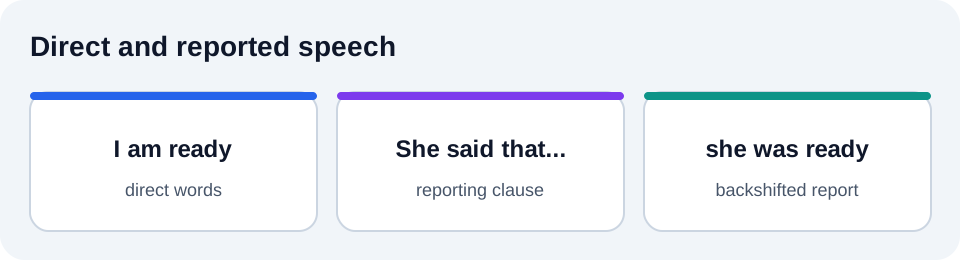
Direct speech quotes someone’s exact words in quotation marks: She said, “I am tired.” Indirect (reported) speech paraphrases the meaning without quotes: She said (that) she was tired. The reported version is not a word-for-word copy — it is a translation of the original statement into a new speaker’s frame of reference. That is why the tense, pronouns, and time words all shift.
Direct vs Indirect Speech
The two forms serve different purposes. Direct speech reproduces the speaker’s exact words, usually to quote or dramatize. Indirect speech reports the content, which is what you do most of the time in essays, summaries, news, and workplace communication.
| Direct speech | Indirect speech |
|---|---|
| He said, “I am hungry.” | He said (that) he was hungry. |
| She asked, “Are you coming?” | She asked if I was coming. |
| “Close the door,” he said. | He told me to close the door. |
Notice the shifts in the right column: am → was, are → was, “Close the door” → to close the door. Every shift below has a reason. Once you see the reasons, the whole system clicks.
Why & How Tenses Backshift
Imagine the timeline. Yesterday, Maria said “I am busy.” Today, you report it: Maria said she was busy. The original “I am” described Maria’s state at the moment she spoke — a moment now in the past. Reporting her past words naturally uses a past tense. This is backshifting: the quoted tense moves one step back to match the reporting frame. Because backshifting leans on the same past-time logic as the tenses themselves, the present perfect vs. simple past guide makes a useful companion read.
| Direct tense | Reported tense | Example |
|---|---|---|
| present simple | past simple | “I work here.” → She said she worked there. |
| present continuous | past continuous | “I am waiting.” → He said he was waiting. |
| present perfect | past perfect | “I have finished.” → She said she had finished. |
| past simple | past perfect | “I saw him.” → He said he had seen him. |
| will | would | “I will come.” → She said she would come. |
| can | could | “I can help.” → He said he could help. |
Time & Place Words
Words like now and here describe the original speaker’s moment and location. When you report from a different time and place, those words must shift to match your frame.
| Direct | Reported | Example |
|---|---|---|
| now | then / at that time | “I am busy now.” → She said she was busy then. |
| today | that day | “I’ll finish today.” → He said he would finish that day. |
| tomorrow | the next day / the following day | “I fly tomorrow.” → She said she flew the next day. |
| yesterday | the day before | “I arrived yesterday.” → He said he had arrived the day before. |
| here | there | “Wait here.” → She told me to wait there. |
| this / these | that / those | “I like this.” → He said he liked that. |
The logic is identical to backshifting: the words are anchored to the original speaker’s time and place, so reporting them from your own frame moves them outward. If you report immediately in the same location, the shifts feel optional — that’s fine and natural.
Pronoun Changes
Pronouns change to reflect who is now speaking. The original I becomes whoever reported the statement; you becomes the person being addressed now.
Work out who each pronoun refers to in the original situation, then rebuild the sentence from the reporter’s perspective. This is the step that causes the most errors in essay writing because learners copy the original pronouns mechanically.
Reported Questions
Reported questions are not questions anymore — they become statements. That means statement word order, no auxiliary do, and no question mark.
| Question type | Direct | Reported |
|---|---|---|
| Yes / No | “Are you ready?” | He asked if I was ready. |
| Yes / No | “Do you drive?” | He asked whether I drove. |
| Wh- | “Where do you live?” | She asked where I lived. |
| Wh- | “What time is it?” | He asked what time it was. |
Watch the word order: She asked where did I live. → She asked where I lived. Drop the auxiliary and use statement order. If and whether both work for yes/no questions.
Reported Commands & Requests
Commands and requests use a different pattern: reporting verb + object + to-infinitive. The imperative verb becomes an infinitive.
| Direct | Reported |
|---|---|
| “Close the door.” | He told me to close the door. |
| “Please wait.” | She asked me to wait. |
| “Don’t be late.” | He told me not to be late. |
| “Could you help me?” | She asked me to help her. |
Tell is the natural verb for commands (told me to), and ask for requests (asked me to). For negative commands, the not goes before to: told me not to. Never write He told me to don’t.
15 Expressive Reporting Verbs
Said is the workhorse, but it carries no tone. Swapping in a more precise reporting verb upgrades your writing instantly — in essays, reports, and professional summaries.
| Verb | Meaning / tone | Example |
|---|---|---|
| stated | formal, factual | The report stated that sales rose 10%. |
| explained | gave reasons | She explained why the delay happened. |
| mentioned | briefly noted | He mentioned that the contract was ready. |
| suggested | soft proposal (+ that or -ing) | She suggested reviewing the plan. |
| insisted | defensive, firm | He insisted that he had paid. |
| recommended | expert advice | The doctor recommended resting. |
| promised | commitment (+ to) | She promised to call back. |
| admitted | reluctant truth | He admitted making the mistake. |
| denied | refused the claim (+ -ing) | She denied seeing the email. |
| claimed | asserted, possibly unproven | He claimed he was at home. |
| warned | danger warning (+ about/against) | She warned us about the deadline. |
| complained | negative report | He complained that the office was cold. |
| replied | answered | She replied that she was on the way. |
| confirmed | verified | The client confirmed the order. |
| added | extra point | He added that prices would hold. |
Two patterns to remember with reporting verbs: some take that + clause (stated, insisted, claimed), some take -ing (suggested, admitted, denied, recommended), and some take to + verb (promised, agreed, offered). Matching the verb to its pattern is half the battle. The -ing and to + verb patterns belong to the same family as infinitive and gerund complements — the gerunds vs. infinitives rulebook covers them in depth.
Common Mistakes
The said/told confusion is so common that it deserves its own practice set: try these say vs. tell exercises after you finish this guide.
Test Yourself
Rewrite each direct sentence in reported speech, then check the answers.
1. “I am working late,” she said.
Answer: She said she was working late.
2. “Did you finish the report?” he asked me.
Answer: He asked me if I had finished the report.
3. “Don’t touch that button,” the engineer told us.
Answer: The engineer told us not to touch that button.
4. “We will announce the results tomorrow,” they said.
Answer: They said they would announce the results the next day.
5. “Where is the nearest station?” she asked.
Answer: She asked where the nearest station was.
6. “I have never seen this film,” he admitted.
Answer: He admitted that he had never seen that film.
Turn Reporting into a Writing Skill
Reported speech is everywhere in academic and professional writing: summarizing interviews, citing sources, recapping meetings. The best practice is to take a news quote and rewrite it three ways — once with said, once with a precise reporting verb, and once as a reported question. Each rewrite forces you through the full set of changes.
PromGee’s grammar and tenses categories include reported-speech exercises that test the full transformation at once — tense, pronoun, time word, and word order — with AI explanations for every shift. That integrated practice is what makes the system click.
When you write a summary, consciously vary your reporting verbs and check each one against its pattern (that-clause, -ing, or to-infinitive). Two focused weeks of this habit will remove most reported-speech errors for good.
Indirect speech reports meaning, not exact words. With a past reporting verb, tenses backshift one step; pronouns, time words, and place words shift to your frame. Reported questions use statement order with if/whether or the wh-word. Commands become tell + person + to-infinitive. Choose precise reporting verbs and match each to its pattern. The changes all follow the same logic: you are translating another person’s words into your own time and place.