In, On, At : les Prépositions Anglaises
Pourquoi in the morning mais on Monday mais at 9 o'clock ? Parce que l'anglais organise le temps et l'espace sur trois niveaux : le général, la surface et le point. Une seule idée pour comprendre les prépositions anglaises in, on, at — plus les exceptions que tout le monde apprend par cœur.
Entraînement gratuit: Exercices gratuits de grammaire anglaise (avec corrigés)
1« Le lundi » se dit…Voir la réponse
2« En 2026 » se dit…Voir la réponse
3« À 9 heures » se dit…Voir la réponse
4« Dans le restaurant » (pour manger) se dit…Voir la réponse
Pourquoi les prépositions piègent les francophones
Le français utilise en grande partie le même mot « à » et « en » pour tout : à Paris, à 9 heures, en 2026, en voiture. L'anglais, lui, découpe le monde en trois zones : in (dans, général), on (sur, surface), at (à, point). Résultat : traduire « à » mot à mot est impossible.
In, on, at pour le temps
| Préposition | Précision | Exemples |
|---|---|---|
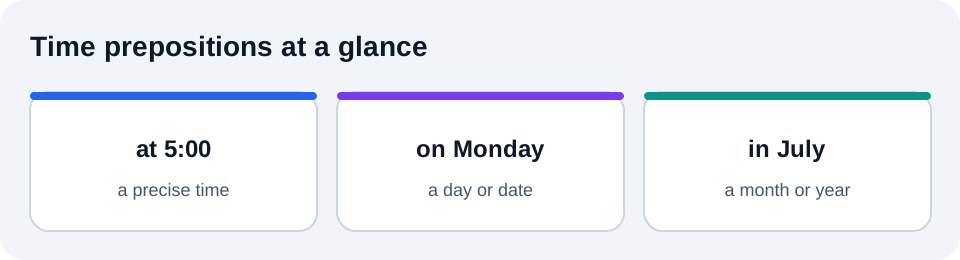
| IN | général (grand) | in 2026, in August, in winter, in the morning, in the 21st century |
| ON | jour / date précise | on Monday, on the 10th of August, on my birthday, on New Year's Day |
| AT | heure / moment exact | at 9 o'clock, at noon, at midnight, at the weekend (GB), at the moment |
In, on, at pour le lieu
| Préposition | Logique | Exemples |
|---|---|---|
| IN | à l'intérieur / grand espace | in Paris, in France, in the garden, in my bag, in the office (lieu) |
| ON | sur une surface | on the table, on the wall, on the floor, on the bus, on the coast |
| AT | point / lieu d'activité | at the door, at the corner, at the airport, at school, at work, at the restaurant (dîner) |
La nuance at/in : at school = on y est pour étudier (activité), in the school = on est dans le bâtiment. De même at the restaurant (y dîner) contre in the restaurant (être à l'intérieur du bâtiment).
Les exceptions à connaître
In, on, at dans les expressions fixes
Les erreurs typiques des francophones
Exercices
Complète par in, on ou at :
1. We're meeting ___ 5 o'clock.
Réponse : at (heure précise)
2. She was born ___ 1995.
Réponse : in (année)
3. The keys are ___ the table.
Réponse : on (surface)
4. My birthday is ___ March 3rd.
Réponse : on (date précise)
5. I'm really good ___ cooking.
Réponse : at (bon à)
6. They arrived ___ Paris late at night.
Réponse : in (grand espace)
Questions fréquentes
Pourquoi 'at home' et pas 'in home' ?
at home est une expression fixe : on est au point « maison ». Mais on dit bien in my house, in the kitchen. Retenez : at home, tout court.
'On time' ou 'in time' ?
on time = à l'heure prévue (The train arrived on time). in time = à temps, juste assez tôt (We got there in time for the movie).
Faut-il une préposition avec 'every day' ou 'last week' ?
Non. Last Monday, next year, every day, this morning, today — aucune préposition. C'est une règle simple qui évite beaucoup d'erreurs.
Comment progresser sur les prépositions ?
Apprenez-les par blocs, pas une par une : le système in/on/at pour le temps, puis pour le lieu, puis les expressions fixes. Avec PromGee, entraînez-vous par situation jusqu'à ce que ce soit automatique.
In, on, at = trois niveaux de zoom. Temps : in (années, mois, saisons, moments du jour), on (jours, dates), at (heures, midi, nuit). Lieu : in (intérieur, grands espaces), on (surfaces, transports à bord), at (points, activités). Mémorisez les expressions fixes (at home, at night, on time, interested in) et les pièges des francophones : going to Paris, married to, listen to, afraid of.
Les prépositions, un jeu d'enfant avec de l'entraînement
PromGee propose des exercices ciblés par préposition, avec correction instantanée et explications en français.
Commencer gratuitement avec PromGee